

When you wander through the ancient streets of Chinese cities or catch a glimpse of inscriptions on the walls of Teahouses, those straight and curved Chinese characters are far more than simple symbol combinations. As one of the oldest existing ideographic writing systems in the world, Chinese characters have evolved from oracle bone script to the present day, with each stroke carrying the life philosophy, value pursuit and cultural genes of the Chinese nation. For foreign travelers, understanding the meanings of Chinese characters is like obtaining a key to unlock the code of Oriental civilization, allowing you to deeply feel the warmth and depth of Chinese Culture.
![图片[1]-Chinese Character Meanings: Oriental Cultural Code in Strokes](https://www.dgcity.com/wp-content/uploads/2026/01/image-99-1024x605.png)
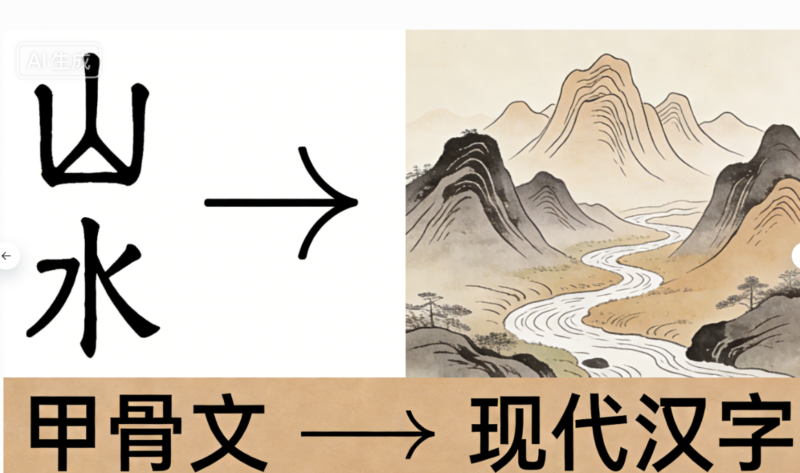
The beauty of the meanings in Chinese characters first stems from their essence of “unity of form and meaning”. Unlike phonetic writing, the form of a Chinese character is often closely linked to the meaning it expresses, initially created through pictography, self-explanation, associative compounding and other methods. For example, the character “山” (mountain) in oracle bone script resembles three rolling peaks, outlining the shape of mountains with just a few strokes. Even those who do not understand Chinese can vaguely guess its meaning by its form; the character “水” (water) simulates the surging state of water with winding strokes, embodying the ancient people’s careful observation of all things in nature. This characteristic of “expressing meaning through form” makes each Chinese character a miniature painting, with every stroke hiding the ancient people’s understanding of the world.
In addition to pictographs, associative compound characters carry more layered meanings, conveying rich connotations through the combination of multiple character forms. The character “家” (family) is a typical example. The upper part is “宀”, symbolizing a house that shelters from wind and rain, and the lower part is “豕” (the ancient name for pig). In ancient agricultural society, pigs were a symbol of family wealth and prosperity. Having a pig under the house constitutes the core image of “home” — both a place to live and abundant resources, implying the Chinese people’s yearning for a stable family and a prosperous life. Another example is the character “仁” (benevolence), composed of “人” (person) and “二” (two), meaning the way people get along with each other. It is the visualization of the core Confucian idea of “loving others as oneself”, highlighting the Chinese value of emphasizing interpersonal relationships and harmonious coexistence.
![图片[2]-Chinese Character Meanings: Oriental Cultural Code in Strokes](https://www.dgcity.com/wp-content/uploads/2026/01/image-100.png)
The meanings of Chinese characters are also reflected in the inheritance of radicals, with different radicals often carrying fixed cultural implications. Radicals like “氵” (water radical) are mostly related to water, such as “清” (clear), “澈” (transparent) and “润” (moist). They not only describe the form and characteristics of water but also derive extended meanings of purity and nourishment, which is why the Chinese often use “clear water” to metaphorize the character of a gentleman. Radicals like “木” (wood radical) are mostly related to plants, such as “林” (forest), “森” (jungle), “松” (pine) and “柏” (cypress). They not only reflect the growth state of plants but also endow them with meanings of tenacity, uprightness and vitality. Pine and cypress trees, in particular, have become symbols of longevity and perseverance due to their evergreen nature. These radicals are like “cultural gene fragments” of Chinese characters, passing down the ancient people’s life experience and value judgments from generation to generation.
In contemporary China, the meanings of Chinese characters are still deeply integrated into people’s daily lives, serving as a carrier of emotional expression and cultural identity. During the Spring Festival, every household pastes the character “福” (blessing). People usually paste it upside down, taking the homophone meaning of “blessings arrive”, expressing their wishes for good luck in the new year. The character “囍” (double happiness), commonly seen at weddings, is composed of two “喜” (happiness) characters, symbolizing pairing and happy marriage, a blessing for the couple’s happy life. The character “寿” (longevity), through different calligraphic forms, has become the core element in birthday celebrations, conveying wishes for the elderly’s health and longevity. In addition, many Chinese characters are endowed with good meanings due to homophones. For example, “鱼” (fish) is homophonic with “余” (surplus), meaning “having surplus year after year”; “莲” (lotus) is homophonic with “连” (continuous), meaning “promotion step by step” and “having a noble son”, these homophonic meanings have long been integrated into folk Culture and become part of Chinese life.
For foreign travelers, understanding the meanings of Chinese characters can not only help you better understand China’s folk customs, calligraphy and literary works but also feel the Chinese nation’s way of thinking of “observing things to get images, and deriving meanings from images”. Each Chinese character is a microcosm of history, and each stroke’s meaning is a cultural inheritance. When you see the character “和” (harmony) on the plaque of the Hall of Supreme Harmony in the Forbidden City, you will know it contains the pursuit of “harmony between man and nature, and great unity of the world”; when you read the character “堤” (dyke) at Su Causeway by West Lake, you will think of the ancient people’s wisdom in controlling floods to protect people and beautify mountains and rivers. With its unique charm, Chinese characters closely connect the past and the present, nature and humanity, becoming a cultural bridge spanning time and space.
Today, more and more foreigners are beginning to learn Chinese characters, not only for communication but also to explore the Oriental wisdom behind them. When you write the character “人” (person) with your own hands, you will understand that its left and right strokes support each other, symbolizing the mutual support between people; when you write the character “和” (harmony), you will understand that its balanced structure hides the Chinese people’s pursuit of a harmonious society. The meanings of Chinese characters have long transcended the characters themselves, becoming a cultural belief and spiritual sustenance, waiting for every distant traveler to explore and perceive.









暂无评论内容