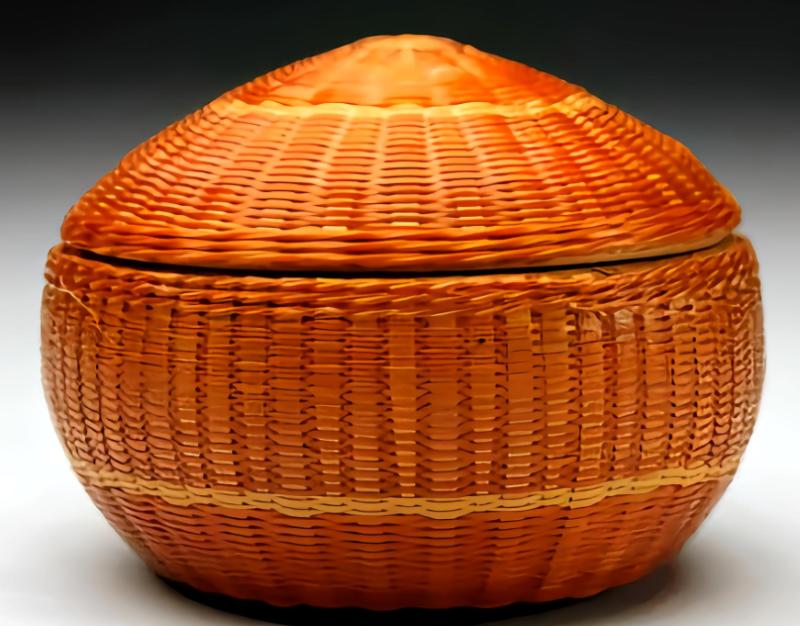


Across the vast land of China, bamboo is more than just a common plant in mountains and fields—it carries thousands of years of cultural heritage and artisanal spirit. Bamboo weaving, a traditional craft that uses bamboo as raw material and is created by hand, acts like an invisible link connecting the wisdom of life and aesthetic pursuit of the Chinese nation. Having stood the test of time, it shines even brighter. As a practical daily utensil and a treasure listed in the intangible cultural heritage, bamboo weaving tells the world the unique charm of traditional Chinese craftsmanship.
The history of bamboo weaving dates back to the Neolithic Age. Archaeological discoveries show that as early as over 7,000 years ago, fragments of bamboo woven artifacts were found at the Hemudu Site in Yuyao, Zhejiang Province. At that time, ancient ancestors utilized bamboo’s strong toughness and easy processability to weave baskets, mats, and sieves, which were indispensable for storing, drying, and living. With the development of society, bamboo weaving techniques gradually matured during the Xia, Shang, and Zhou dynasties, became popular in the Qin and Han dynasties, and reached their peak in the Tang and Song dynasties. It not only formed a variety of weaving techniques but also integrated the aesthetic taste of literati, upgrading from practical utensils to works of art with both ornamental and artistic value. In the Ming and Qing dynasties, bamboo weaving became more refined, with complex techniques such as hollowing, jacquard, and dyeing emerging. Production areas also formed their own characteristics, such as Dongyang in Zhejiang, Qingshen in Sichuan, and Jiangle in Fujian, which became renowned hometowns of bamboo weaving.
![图片[1]-Chinese Bamboo Weaving - Intangible Cultural Heritage Traditional Craft](https://www.dgcity.com/wp-content/uploads/2026/01/image-75.png)
The charm of Chinese bamboo weaving lies in its creative concept of “harmony between man and nature” and exquisite weaving techniques. The selection of raw materials for bamboo weaving is extremely strict. Craftsmen usually choose high-quality bamboo varieties such as moso bamboo and neosinocalamus affinis that have grown for 3 to 5 years. After multiple processes including cutting, splitting, drying, and smoking, the hard bamboo is processed into thin and flexible bamboo strips and threads. Among these, splitting bamboo is the most demanding skill—only with a small knife, craftsmen can split bamboo stems into uniform strips, and the thinnest bamboo threads are even finer than human hair while maintaining sufficient toughness. In terms of weaving techniques, bamboo weaving covers dozens of methods such as warp and weft weaving, interspersed weaving, winding weaving, and jacquard weaving. Without drawings, craftsmen rely solely on hand feel and experience to interweave bamboo threads and strips into intricate and exquisite patterns. From simple flat weaving to three-dimensional utensil shapes, from plain single-color weaving to colorful patterns, each bamboo weaving work embodies the craftsman’s dedication and wisdom, showing the artistic realm of “made by man, yet as if created by nature.”
![图片[2]-Chinese Bamboo Weaving - Intangible Cultural Heritage Traditional Craft](https://www.dgcity.com/wp-content/uploads/2026/01/image-74-1024x717.png)
Over the long course of development, bamboo weaving has been deeply integrated into all aspects of Chinese people’s lives. In traditional agricultural society, bamboo baskets were used for picking vegetables and fruits, storing grain; bamboo mats for cooling in summer; bamboo sieves for sifting grains; and bamboo cages for raising poultry, becoming important tools for daily production and life. Meanwhile, bamboo weaving also entered literati studies and imperial palaces. Bamboo woven brush holders, pen racks, and vases, with their simple texture and elegant shapes, became carriers for literati to adorn their lives and express their feelings. Bamboo weaving crafts in the imperial palace were even more exquisite, often matched with gold, silver, jade, and other materials to show royal majesty. Today, with the change of lifestyle, the practical function of bamboo weaving has gradually weakened, but its artistic value and cultural significance have become more prominent. On the basis of inheriting traditional techniques, modern craftsmen continue to innovate, combining bamboo weaving with modern design to develop bamboo woven decorations, clothing accessories, home ornaments, and other products, allowing this ancient craft to re-enter modern life and glow with new vitality.
![图片[3]-Chinese Bamboo Weaving - Intangible Cultural Heritage Traditional Craft](https://www.dgcity.com/wp-content/uploads/2026/01/image-73.png)
As an important part of China’s intangible cultural heritage, bamboo weaving is not only a craft but also a cultural symbol, embodying the Chinese people’s reverence for nature, love for life, and adherence to craftsmanship. It has witnessed the changes of Chinese society, condensed the aesthetic pursuit and creative wisdom of the Chinese nation, and is an indispensable part of Chinese civilization. Today, more and more people are paying attention to bamboo weaving. Craftsmen pass on this millennium-old skill through opening classes and online exhibitions. For foreign tourists, understanding Chinese bamboo weaving not only allows them to feel the exquisite charm of traditional crafts but also deeply touch the profound heritage of Chinese Culture, and experience the Chinese philosophy of “harmony between man and nature” and the spirit of craftsmanship.






暂无评论内容