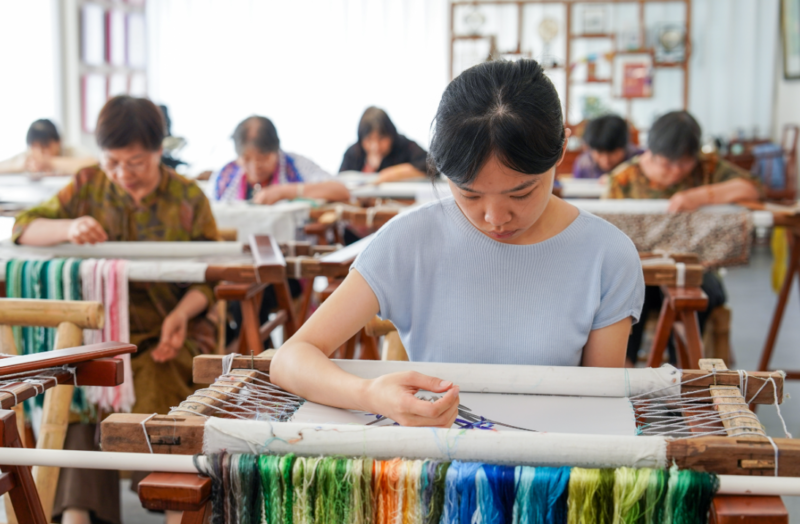


In the long river of China’s splendid traditional handicrafts, Su Embroidery, renowned as the leader of “China’s Four Great Embroideries”, shines as an indispensable pearl of Oriental aesthetics with its exquisite stitches, elegant style and superb craftsmanship. Originating in the Wu County area of Suzhou, Jiangsu Province, it has undergone inheritance and evolution for more than 2,000 years, surpassing the scope of a simple embroidery craft to become an art form carrying the cultural heritage and aesthetic pursuit of the Chinese nation. It is also a highly representative cultural symbol in Sino-foreign cultural exchanges, attracting countless foreign tourists to explore it with admiration.
![图片[1]-Su Embroidery Production Process: An Introduction to the Treasure of Oriental Traditional Handicrafts-Dgcity-Discover Great Chinese City](https://www.dgcity.com/wp-content/uploads/2026/01/image-48-1024x671.png)
The origin of Su Embroidery can be traced back to the Spring and Autumn Period and the Warring States Period. At that time, the handicraft industry in Suzhou was well-developed, and the embroidery technique had initially taken shape. After developing in the Qin and Han Dynasties, flourishing in the Tang and Song Dynasties, it reached its peak in the Ming and Qing Dynasties, becoming a tribute to the imperial court and a treasure collected by literati and scholars. Embroiderers of all dynasties integrated life insights, Natural Scenery and cultural connotations into their needles and threads, enabling Su Embroidery to form eight characteristics: flatness, neatness, delicacy, density, uniformity, smoothness, harmony and luster. Each characteristic embodies the craftsmanship and wisdom of the artisans. Flatness means the embroidery surface is smooth and flat without a sense of unevenness; neatness refers to the orderly arrangement of stitches and clear edge contours; delicacy means the embroidery threads used are as thin as silk, and even a single silk thread can be split into dozens of strands; density represents the tight and scattered stitches without exposing the background color; uniformity requires the embroidery threads to be of uniform thickness and the stitches to be evenly dense; smoothness means the direction of the silk threads fits the texture of the pattern, natural and fluent; harmony refers to the elegant and harmonious color matching with natural transitions; luster means the embroidery surface is glossy with a delicate and warm texture.
![图片[2]-Su Embroidery Production Process: An Introduction to the Treasure of Oriental Traditional Handicrafts-Dgcity-Discover Great Chinese City](https://www.dgcity.com/wp-content/uploads/2026/01/image-47.png)
A delicate Su Embroidery work needs to go through dozens of processes from design to completion, taking several months to several years. No carelessness is allowed in each step. First is material selection. Su Embroidery has high requirements for the base material and embroidery thread. The base material is mostly soft and breathable silk or satin, and the embroidery thread is mainly natural silk, which is full in color and strong in toughness. Some high-end works also use gold and silver threads for decoration. Second is design and drafting. Craftsmen need to accurately draw patterns on the base material according to the creative theme. Whether it is flowers, birds, fish and insects, landscapes, figures, or calligraphy and poetry, they must take into account both the beauty of composition and the feasibility of embroidery, retaining the charm of the original work while reserving space for subsequent stitch techniques.
Stitch technique is the soul of Su Embroidery. After thousands of years of inheritance, Su Embroidery has developed more than 100 kinds of stitches, with dozens of commonly used ones such as even stitch, overlay stitch, application stitch, virtual-real stitch and random stitch. Different stitches are suitable for presenting different patterns and effects. The even stitch is the most basic one, with straight lines, often used for outlining contours and filling the background color; the overlay stitch achieves gradual color transition through layers of silk threads, making the feathers of flowers and birds and the clouds of landscapes more layered; the random stitch breaks the regularity of traditional stitches, simulating the light and shadow effect of Western painting with irregular stitches, making the work more three-dimensional and artistically appealing. For example, when embroidering peonies, craftsmen use overlay stitch to show the gradual color of the petals, application stitch to outline the veins of the petals, and virtual-real stitch to present the light and shadow contrast of flowers and leaves. With every stitch, the elegance and luxury of peonies are vividly displayed; when embroidering kittens, the silk thread is split to the extreme thinness, and the soft and fluffy hair is restored with dense stitches, even accurately presenting the reflection in the cat’s eyes, achieving a lifelike effect.
![图片[3]-Su Embroidery Production Process: An Introduction to the Treasure of Oriental Traditional Handicrafts-Dgcity-Discover Great Chinese City](https://www.dgcity.com/wp-content/uploads/2026/01/image-49.png)
Today’s Su Embroidery not only adheres to traditional essence but also constantly innovates and develops. Traditional Su Embroidery mostly takes landscapes, flowers, birds, figures and auspicious patterns as themes, conveying the Chinese people’s awe of nature and yearning for a better life; modern Su Embroidery integrates Western art elements and contemporary design concepts, with more diverse themes, including reproductions of classic paintings, interpretations of urban scenery and abstract art. At the same time, it has broken through the traditional application scenarios of paintings, calligraphy and clothing, extending to home decoration, cultural and creative products, custom gifts and other fields, making this ancient craft more in line with contemporary life.
For foreign tourists, Su Embroidery is not only an exquisite handicraft but also a window to understand Chinese Culture. Every Su Embroidery work contains the aesthetic taste and life wisdom of the Chinese people. From the delicate stitches, one can understand the Chinese nation’s pursuit of refinement and elegance; from the rich patterns, one can explore the profound heritage of Chinese traditional culture. Today, many embroiderers in Suzhou still adhere to this craft, inheriting the cultural genes of Su Embroidery. Many Su Embroidery workshops are also open to Chinese and foreign tourists, allowing people to get close to the production process of Su Embroidery and personally touch this Oriental aesthetic treasure on the fingertips.








暂无评论内容